Growth is Not Win-Win any more
When a raise for the 1% used to be a win-win
At one point in history, it was true that if the 1% got a big raise, but everyone got a raise, everyone was better off. Let me show you how that math works.
This post is also available as a video essay on Youtube: https://youtu.be/gqSWVwRHpgA
Let’s imagine that there is a company and everyone makes $1,000 a year. This was back a long time ago, we’ll say. One of the workers stands up and says, “I’ve got a great idea that’s going to double our company’s income. Everybody’s going to get a really big raise this year, but it’s my idea. It’s only fair that I should get a very big raise.” Everybody talks this over and they say, “Okay, sure. If you double the company’s income, you can have a salary increase of ten times.” And then they laugh because nobody can double the company’s income.
But in our fable, this guy is really, really smart. He does come up with an idea that doubles the company’s income. Now the company has enough to pay everyone $2,000 a year. But it can’t pay everyone $2,000 a year because they’ve elected him CEO now and they pay him $10,000 a year. The other 99 people still get about $1,919 each. So they’re almost doubling their income, and the CEO’s good idea made that possible. Everyone agrees that it’s pretty fair that he should get a lot of money.
This is the premise by which CEOs have historically extracted very large salaries: they are very important and entitled to a disproportionate part of the gains the company makes. Everyone agrees because it’s a win-win. The workers’ income may not go up by as big a percentage as the CEO’s, but it still goes up in absolute terms.
Adding steady growth plus an out-sized raise
Let’s play this out a little farther. Suppose the total amount of money available to pay salaries grows by 2% per year because the CEO’s decisions grow the company consistently at a modest rate. The CEO still thinks he deserves a disproportionate raise, so he gives himself a 4% per year raise. He’s responsible for all of that increase — why shouldn’t he have a disproportionate share of the bounty?
Watch what happens when the company’s total pay pool grows at 2% and the CEO’s pay grows at 4%.
At first, and for quite a while, this all still works. The CEO gets his 4% raise every year. The 99% get their almost-2% per year. But then, after a while, that “almost 2%” starts to shrink toward 1%. Eventually, when the CEO’s pay becomes very, very large relative to others — when his salary has grown to be a hundred times the other folks’ pay — his 4% raise starts to eat into the other workers’ raises and then actually starts causing their incomes to go down.
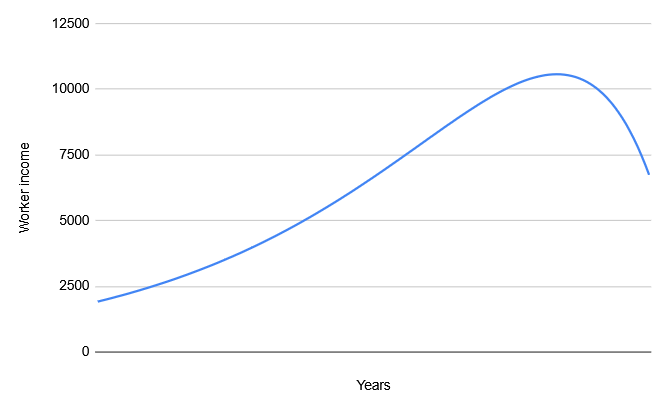
Exponential growth, leveling, decline
What you get is this: a nice, slow exponential growth that makes everybody feel like winners. Then it slows and levels off. And then it starts to tip down. The CEO is still looking at this and thinking, “Of course I should get a 4% raise. I always get a 4% raise. It’s only fair. I’m very important and I’m making good decisions. It’s my hard work that makes sure the company grows by a steady amount every year. Why shouldn’t I get a disproportionate reward?”
But his disproportionate reward now comes directly at the expense of lower salaries for the workers. It has to. It’s growing faster than the company. Eventually, it will be all of the company.
The silly extreme and the math behind it
Consider the silly extreme where the CEO’s salary amounts to all the money available to pay salaries — he gets the whole pie. If he still wants a 4% increase in his salary but the company only grew by 2%, he can’t have it; there is nowhere for that extra money to come from. Where did it come from before? It had to come from someone else’s salary.
This basic idea — that when capital (or top incomes) grows faster than labor and faster than the economy at large, eventually it must eat someone else’s share of available resources — comes directly from the math. It doesn’t always manifest immediately; it only becomes obvious when income inequality is large enough. And therein is the deception: when this dynamic started, it was true that the CEO could ask for a disproportionate reward and everyone was still winning. But once inequality gets big enough, it just doesn’t work anymore. That’s where we are right now.
PS:
If you want an ad-free and tracker-free version of this post to read or share, you can find me at a2facts.com. The a2facts.com project is dedicated to scientifically grounded political critique. This essay ©2026 by John Brown is licensed under Creative Commons Attribution 4.0 International. Please share, remix, and reprint and cite as: “Growth is Not Win-Win any more” by John Brown is licensed under CC BY 4.0